

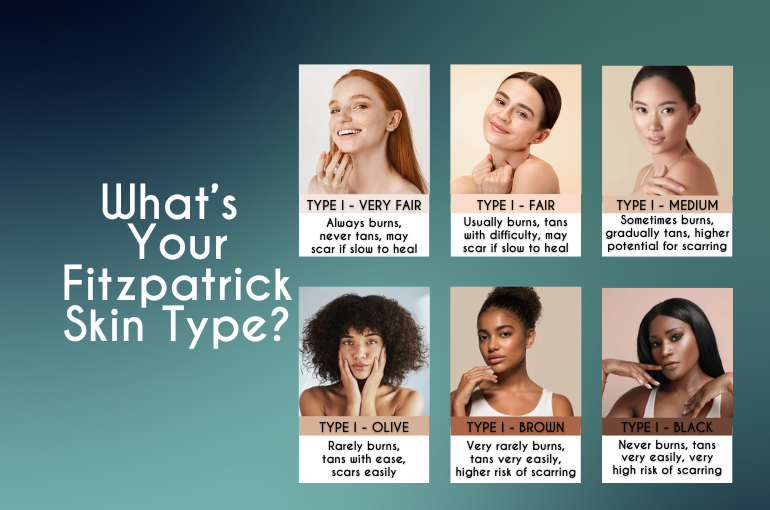
What’s Your Fitzpatrick Skin Type?
When it comes to your skin, knowledge is power – especially during Skin Cancer Awareness Month. At Dermoperfection, one of the first steps we take when creating your personalised treatment plan is identifying your Fitzpatrick skin type. But what exactly is this, and why does it matter?
The Fitzpatrick scale is a classification system that identifies how your skin reacts to ultraviolet (UV) light – including how easily you burn or tan. This not only helps assess your risk of sun damage and skin cancer, but also guides us in recommending the most effective and safest treatments and skincare products for your skin.
Fitzpatrick Skin Type I – Very Fair Skin
If you have very pale or porcelain skin that always burns and never tans, you’re likely a Type I. This skin type often has light blue or green eyes and red or blonde hair.
- Key characteristics: Highly sensitive to the sun, prone to redness and irritation, needs strong sun protection year-round.
- Risks: Higher risk of sunburn and skin cancer due to very low melanin levels.
Fitzpatrick Skin Type II – Fair Skin
Type II skin is still fair, but may tan very lightly. However, it burns easily, and sun exposure should still be approached with caution. You might have light eyes and blonde or light brown hair.
- Key characteristics: Some tanning, but often accompanied by sunburn; requires high-SPF skincare and daily sun protection.
- Risks: Still at significant risk for sun damage and premature ageing.
Fitzpatrick Skin Type III – Medium Skin
People with Type III skin sometimes burn, but tan gradually to a light brown. This skin type often has a neutral undertone and is common in those of Southern European descent.
- Key characteristics: More tolerant to sun exposure, but not immune to sun damage.
- Risks: Can develop hyperpigmentation or sunspots with unprotected exposure.
Fitzpatrick Skin Type IV – Olive or Light Brown Skin
Type IV skin rarely burns and tans easily. It has a natural resistance to the sun but still needs protection to avoid long-term damage.
- Key characteristics: Warm undertones, may be prone to post-inflammatory pigmentation (especially after breakouts or treatments).
- Risks: May not notice sun damage until it becomes more visible (e.g., pigmentation, uneven tone).
Fitzpatrick Skin Type V – Brown Skin
This skin type very rarely burns and tans deeply. Type V skin has more melanin, offering some natural protection from the sun.
- Key characteristics: Prone to pigmentation changes, especially with inflammation or incorrect product use.
- Risks: While less likely to burn, still at risk of skin cancer – often in areas not typically exposed to the sun (e.g., soles of the feet, under nails).
Fitzpatrick Skin Type VI – Dark Brown to Black Skin
Type VI skin never burns and is deeply pigmented. While it has the highest natural protection from the sun, it’s still essential to care for this skin type thoughtfully.
- Key characteristics: Rich melanin content, very prone to hyperpigmentation and keloid scarring if not treated appropriately.
- Risks: Skin cancer can still occur, often going undetected until later stages.
Which Treatments Suit Your Fitzpatrick Skin Type?
The Fitzpatrick scale was developed in 1975 by Harvard dermatologist Dr Thomas Fitzpatrick, and remains the global standard for classifying skin by how it responds to UV exposure. The six types range from Type I (very fair, always burns) to Type VI (deeply pigmented, never burns). Knowing your type matters because it shapes which aesthetic treatments are safe and effective for your skin and which carry higher risk of pigmentation changes or scarring.
| Skin Type | Generally Well-Suited Treatments | Use With Care |
|---|---|---|
| Type I (Very fair) | Microneedling, chemical skin peels, Profhilo, Hydrafacial, BBL Moxi laser, Fractional CO2 laser, Obagi Medical, Botox, dermal fillers | Daily medical SPF non-negotiable; aggressive sun-tanning treatments not advisable |
| Type II (Fair) | Same as Type I, all major treatments well tolerated | Continued sun protection and antioxidant skincare to limit photo-ageing |
| Type III (Medium) | Full range of treatments including microneedling, peels, BBL Moxi, CO2 laser, Profhilo, injectables | Monitor for hyperpigmentation after inflammation or treatment |
| Type IV (Olive / light brown) | Microneedling, INTRAcel Pro (radiofrequency microneedling), Hydrafacial, Profhilo, injectables, superficial chemical peels | Ablative lasers and high-intensity IPL require careful settings; higher risk of post-inflammatory pigmentation |
| Type V (Brown) | Microneedling, INTRAcel Pro, Hydrafacial, Profhilo, Dermamelan peel (for pigmentation), injectables, gentle chemical peels (mandelic, lactic) | Avoid ablative lasers and high-intensity IPL; select Nd:YAG-based wavelengths where laser is indicated |
| Type VI (Dark brown to black) | Microneedling, INTRAcel Pro, Hydrafacial, Profhilo, Dermamelan peel, injectables, very gentle peels | Strong risk of PIH and keloid scarring; ablative lasers and IPL generally not appropriate; treatment must be led by a practitioner experienced in skin of colour |
If you’re not sure of your type, book a consultation and our medical team will assess you in person.
How Dermoperfection Can Help You Care for Your Skin Type
At Dermoperfection, we don’t believe in one-size-fits-all skincare. Your Fitzpatrick type helps us choose:
- The most effective treatments for your skin (like microneedling, chemical peels, laser therapy, or injectables – all tailored safely to your skin type)
- The best medical-grade products from trusted ranges like Obagi Medical or SkinCeuticals that address your unique concerns – from pigmentation to sensitivity to ageing
- Preventative steps during Skin Cancer Awareness Month and beyond – including SPF education, regular skin checks, and product recommendations that truly protect.
Book a Consultation
Whether you know your Fitzpatrick type or not, our medical experts can assess your skin in-clinic and create a bespoke plan that supports long-term skin health. Book a consultation at our award-winning clinic today!