

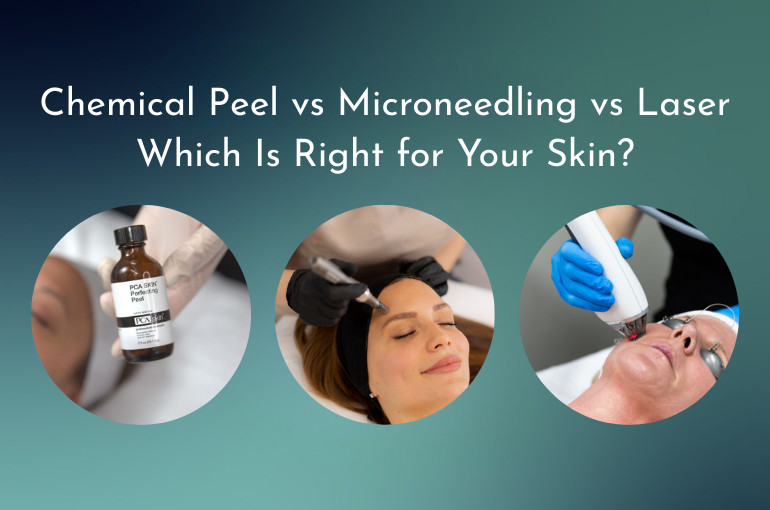
Chemical Peel vs Microneedling vs Laser: Which Is Right for Your Skin?
When comparing skin renewal treatments, chemical peels, microneedling treatments, and laser resurfacing are often discussed together. Each is a popular non-surgical treatment designed to improve skin quality, but they work in different ways and target different skin concerns.
Understanding how these treatments affect the skin from surface exfoliation to deeper collagen stimulation is key to choosing the most effective option for your skin type, condition, and long-term goals.
Chemical Peel vs Microneedling vs Laser: At-a-Glance Comparison
The table below summarises the key practical differences between the three treatments based on what most patients want to know: how much downtime, how much it costs, who it suits best, and when to expect results.
| Factor | Chemical Peel | Microneedling | Fractional CO2 Laser |
|---|---|---|---|
| Downtime | Superficial peels: 0 to 2 days. Medium peels: 3 to 7 days of peeling and redness. Deeper peels (e.g. Dermamelan): up to 2 weeks. | Minimal. Redness and pinpoint bleeding for 24 to 48 hours. Most patients are back to normal in 2 to 3 days. | Significant. 5 to 10 days of redness, peeling, and flaking. Skin fully recovered at 2 to 3 weeks. |
| Typical Cost (per session) | From around £85 (superficial) to £350+ (medium-depth or Dermamelan) | From around £200 per session | From £450 (targeted area) to £950 (full face) |
| Best For | Dullness, pigmentation, uneven tone, sun damage, mild acne, blackheads | Texture issues, mild to moderate acne scarring, fine lines, open pores, stretch marks | Significant sun damage, deeper acne scars, established wrinkles, advanced loss of firmness |
| Results Timeline | Initial glow within 1 to 7 days. Best results after a course of 3 to 6 sessions, spaced 2 to 4 weeks apart. | Visible improvement at 4 to 6 weeks. Best results after a course of 3 to 6 sessions, spaced 4 to 6 weeks apart. Collagen continues building for 6+ months. | Visible improvement within 2 to 4 weeks as healing completes. Continues improving for 3 to 6 months. Often a single session, sometimes a series of 2 to 3. |
| Skin Tone Suitability | Most suitable for Fitzpatrick I-IV. Mandelic acid and gentler formulations are safer for darker skin tones. | Safe across all skin tones, including Fitzpatrick V and VI. | Best for Fitzpatrick I-III. Higher risk of post-inflammatory hyperpigmentation in darker skin tones, alternative lasers may be more appropriate. |
| Pain Level | Mild tingling or warmth. No anaesthetic required for superficial peels. | Mild to moderate. Topical anaesthetic applied 30 minutes before treatment. | Moderate. Topical or local anaesthetic used. |
These figures are typical ranges. The right choice depends on your specific skin concerns, Fitzpatrick type, downtime tolerance, and budget. Confirm exact pricing on our price list.
Chemical Peels: Improving Skin Tone and Surface Clarity
Chemical peels, sometimes referred to as chemical peeling, use a controlled chemical solution to exfoliate the upper layers of the skin. By removing dead skin cells and accelerating cell turnover, chemical peels support visible improvements in skin tone, clarity, and texture.
Chemical peels are commonly used to treat:
- Uneven skin tone
- Dull or tired-looking skin
- Sun damage and sun spots
- Age spots
- Fine lines
- Mild scarring
- Post-inflammatory hyperpigmentation
Because chemical peels focus on surface renewal and controlled exfoliation, they are often suitable for patients looking to brighten the skin and improve overall appearance without deeper intervention.
Microneedling: Collagen Stimulation and Texture Repair
Microneedling treatments, also known as collagen induction therapy, work by creating controlled micro injuries in the skin. These micro injuries trigger a natural healing response, releasing growth factors and increasing collagen production and elastin production at the dermal level.
Microneedling is particularly effective for:
- Acne scars
- Keloid Scarring
- Uneven skin texture
- Reduced skin density
- Early skin laxity
Unlike chemical peels, microneedling does not exfoliate the surface of the skin. Instead, it strengthens the skin from within by encouraging regeneration and improving structural support over time.
Laser Resurfacing: Targeted Treatment at Greater Depth
Laser resurfacing uses focused light energy to treat specific skin conditions at varying depths. Laser treatments create a controlled inflammatory response, encouraging collagen renewal and supporting long-term skin repair.
Laser resurfacing is often considered for:
- Advanced sun-damaged skin
- Deeper wrinkles
- Uneven pigmentation
- Persistent textural irregularities
Because laser treatments interact directly with skin tissue, aftercare and recovery can vary depending on the treatment area, skin type, and intensity used.
How These Treatments Differ in Practice
While all three options aim to improve skin quality, they influence the skin in different ways:
- Our chemical skin peels in Birmingham focus on exfoliation, surface renewal, and improving tone through enhanced cellular turnover.
- Microneedling in Birmingham works deeper within the skin to stimulate collagen and support regeneration, making it well suited to scarring and texture concerns.
- Laser skin resurfacing in Birmingham uses controlled light energy to remove damaged surface layers and stimulate deeper renewal.
The most effective choice depends on how your skin behaves, how deeply the concern sits, and how your skin responds to stimulation.
Which Skin Renewal Treatment Is Right for You?
Choosing the Right Treatment for Your Skin
Selecting the most appropriate treatment involves considering:
- Skin type and sensitivity
- Specific skin concerns, such as acne scars or pigmentation
- History of sun damage or post-inflammatory hyperpigmentation
- Healing response and lifestyle factors
- Desired balance between results and downtime
For some patients, chemical peels may be sufficient to restore brightness and smoothness. Others may benefit more from microneedling or laser treatments, particularly when addressing deeper texture or structural changes.
The Importance of Professional Skin Assessment
No single treatment is universally “best.” Choosing between chemical peels, microneedling, and laser resurfacing requires assessment by experienced skin professionals who understand skin structure, healing patterns, and long-term outcomes.
A consultation with a qualified skin care professional helps ensure treatment options are selected safely, taking into account:
- Skin type and condition
- Current skincare routine and topical treatments
- Risk factors such as sensitivity or previous reactions
- Desired clinical outcomes
At this stage, treatment plans can be tailored to support effective skin regeneration and sustainable results.
Aftercare and Long-Term Results
Appropriate aftercare advice plays an important role in all skin renewal treatments. Supporting the skin barrier during recovery helps optimise outcomes, reduce irritation, and maintain healthy cell renewal.
With the right treatment selection and aftercare, patients can achieve:
- Improved skin texture
- More even skin tone
- Enhanced collagen support
A more rejuvenated appearance with brighter, smoother and younger-looking skin.
At Dermoperfection, skin renewal is approached with expertise, precision, and an understanding that no two skins behave the same. Rather than relying on trends or assumptions, treatments are selected based on how your skin functions, heals, and responds over time.
If you’re considering chemical peels, microneedling, or laser treatments and want clarity on what will genuinely benefit your skin, a professional consultation can help create a plan that’s safe, effective, and tailored to your long-term skin health.
Frequently Asked Questions
Which is best for acne scars: chemical peel, microneedling, or laser?
For mild acne scars (superficial pigmentation marks), a course of medium-depth chemical peels is often sufficient. For moderate acne scarring with textural changes, microneedling is typically the most effective and accessible option. For deep, established acne scars, fractional CO2 laser delivers the most dramatic results but carries the longest downtime. Many patients with significant scarring combine treatments over several months.
Which has the least downtime?
Microneedling has the least downtime. Most patients have 24 to 48 hours of redness and are back to normal activities within 2 to 3 days. Superficial chemical peels can have similar or even less downtime. Fractional CO2 laser has the most significant downtime at 5 to 10 days.
Which is least painful?
Superficial chemical peels are the most comfortable, often described as a mild tingling or warmth, with no anaesthetic required. Microneedling and CO2 laser both use topical anaesthetic and are described as moderately uncomfortable rather than painful.
Can I combine chemical peel, microneedling, and laser treatments?
Yes, and many patients do, but not in the same session. Treatments are typically combined sequentially as part of a personalised plan. A common protocol is microneedling for collagen stimulation paired with seasonal chemical peels for brightness, with CO2 laser reserved for one-off targeted resurfacing. Combining treatments should always be planned with your clinician to allow safe healing intervals between sessions.
Which lasts the longest?
Fractional CO2 laser typically delivers the most long-lasting single result, with improvements that continue for 6 to 12 months and structural changes that can last years. Microneedling and chemical peel results are best maintained through ongoing courses rather than one-off sessions. Microneedling collagen stimulation continues building for 6+ months after a course is completed.
Which is best for darker skin tones (Fitzpatrick V or VI)?
Microneedling is generally the safest choice for darker skin tones, with minimal risk of post-inflammatory hyperpigmentation. Fractional CO2 laser carries a higher pigmentation risk and is typically not recommended for Fitzpatrick V or VI without careful expert assessment. Chemical peels should use gentler formulations like mandelic or lactic acid rather than stronger TCA peels.
Which is the cheapest?
A superficial chemical peel is typically the most affordable single treatment, starting from around £85. However, all three treatments are usually recommended as a course rather than a single session, so the full-course cost is what matters. Microneedling is mid-priced, and fractional CO2 laser is the most expensive per session but often requires the fewest sessions overall.